
STORIES FROM THE ROAD
UPI Payments in India for OCI Cardholders: Complete Setup Guide (2026)
India
10/15/2026 · Published
Updated 15 October 2026 · Practical guide for overseas visitors and Indian-origin travelers
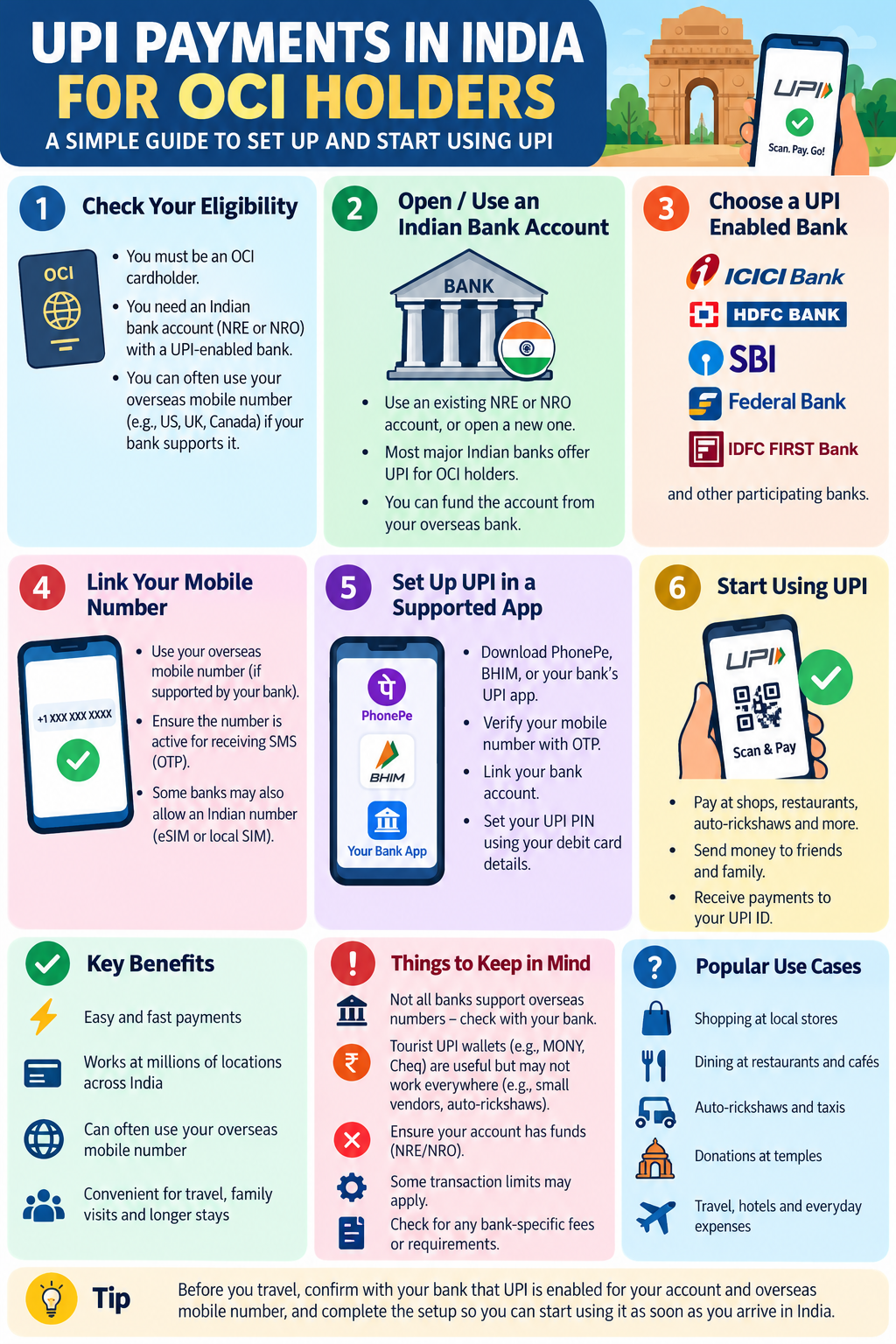
India’s Unified Payments Interface (UPI) allows fast rupee payments by scanning QR codes or entering UPI IDs. For Overseas Citizen of India (OCI) cardholders, the most dependable long-term route is generally an eligible Indian NRE or NRO account linked to a supported mobile number and a compatible UPI app. OCI status by itself does not create a UPI account.
Three different ways to pay
- Route A — Bank-linked UPI: an eligible NRE/NRO bank account, a registered mobile number, a supported bank and app, and a successful UPI PIN setup. Best for repeat visitors and those maintaining Indian banking relationships.
- Route B — Tourist UPI prepaid wallet: a regulated prepaid product such as UPI One World, subject to current issuer availability, identification checks, funding methods and merchant-only restrictions. Useful for short visits without an Indian bank account.
- Route C — Cards and cash: keep an internationally enabled card and modest rupee cash as backup. Neither an OCI card nor an overseas credit card alone guarantees ordinary bank-linked UPI.
Who is eligible?
An OCI cardholder resident outside India may qualify to open eligible non-resident accounts subject to the bank’s KYC and applicable foreign-exchange rules. The RBI describes OCI cardholders within its PIO framework for certain non-resident banking purposes. NRE and NRO accounts have different funding, tax and repatriation treatment; choose on the basis of the source and purpose of funds, not just UPI convenience. Eligibility is determined by residency and banking rules, not solely by possessing an OCI card.
Overseas mobile numbers: the key breakthrough
NPCI permits supported international mobile numbers linked to eligible NRE/NRO accounts to register for UPI. Its published list includes Australia (+61), Canada (+1), France (+33), Hong Kong (+852), Malaysia (+60), Oman (+968), Qatar (+974), Saudi Arabia (+966), Singapore (+65), UAE (+971), UK (+44) and USA (+1). Confirm the latest list before relying on it. The phone must be able to complete the app’s SMS and device verification, which may require international SMS capability, roaming, and the registered SIM or eSIM active on the handset.
Banks to shortlist
NPCI’s published participating-bank list includes AU Small Finance Bank, Axis Bank, Canara Bank, City Union Bank, DBS Bank, Equitas Small Finance Bank, Federal Bank, HDFC Bank, ICICI Bank, IDFC FIRST Bank, IndusInd Bank, Kotak Mahindra Bank, Punjab National Bank, South Indian Bank, State Bank of India and Yes Bank. Inclusion indicates support within the NPCI scheme, not a guarantee that every account variant and app works immediately.
A practical shortlist: ICICI Bank (iMobile), Federal Bank (FedMobile), IDFC FIRST Bank (its mobile app), South Indian Bank (SIB Mirror+), and banks supporting BHIM or PhonePe for the relevant foreign-number flow. HDFC and SBI are also worth checking if you already bank there. No independent bank-wide reliability ranking was established; prefer the bank that confirms your exact country code, NRE/NRO account type, debit-card or PIN setup, and chosen app.
Which app should you use?
NPCI’s published compatible-app list includes BHIM, PhonePe, ICICI iMobile, Federal FedMobile, IDFC FIRST mobile banking, IndusInd BHIM Indus Pay, Kotak mobile banking, South Indian Bank SIB Mirror+ and BHIM AU. This is not an exhaustive promise of functionality on every device. Start with your bank’s own app if it explicitly supports your overseas number, then try an NPCI-listed alternative. Do not assume Google Pay or every familiar UPI app supports foreign-number onboarding for your particular bank.
Documents and preparation checklist
Before leaving for India, assemble: valid foreign passport; OCI card; proof of overseas residence and address; PAN or applicable bank-required tax declarations; a recent photo if requested; bank account information; the registered overseas SIM or eSIM; debit card and its PIN or another bank-approved UPI PIN creation method; access to mobile banking; and the ability to receive and send verification SMS. Exact KYC documentation varies by bank and customer status. Never disclose an OTP, card PIN or UPI PIN to an agent.
Step by step: establish a bank-linked UPI account
- Confirm your eligibility and choose the NRE or NRO account or accounts appropriate to the origin and use of funds.
- Ask the bank in writing: does UPI onboarding work for my country code, my account type and the specific app? Can I finish setup abroad?
- Complete account opening and KYC, including any in-person or video verification required.
- Register the overseas mobile number on the bank account exactly as required; verify the country code.
- Activate mobile banking and any eligible debit card before attempting UPI.
- Install the official app from its publisher. Select the overseas-number registration route if available, grant necessary SMS permissions and keep the registered SIM active.
- Allow the app to send its verification SMS; check SMS charges and roaming capability. If dual-SIM, choose the correct SIM.
- Select the linked bank account, establish the UPI PIN using the method the bank supports and create a UPI ID.
- Make a small test payment to a verified merchant, inspect the beneficiary name and confirm the debit and receipt.
- Test the QR codes and payment types you will actually need, then retain card and cash backup.
How to fund payments
Bank-linked UPI spends existing rupee balances in the linked eligible account; it is not a standalone balance that must be topped up. NRE accounts typically receive eligible foreign inward remittances and other permitted credits; NRO accounts commonly handle permitted India-source receipts and transfers. Ask the bank about exchange-rate spreads, inward-remittance charges, transfer restrictions and taxes. Tourist wallets have separate loading, refund, expiry, transaction-limit and fee rules: obtain the issuer’s current written schedule before loading substantial funds.
Tourist wallets: benefits and limitations
UPI One World is a prepaid instrument designed for eligible inbound visitors. NPCI material describes passport or visa-based verification through authorized issuer touchpoints, loading Indian rupees and paying UPI-enabled merchants. Availability, accepted OCI documentation, geographic onboarding, reload methods and refunds must be verified with the live issuer. Prepaid tourist offerings can be merchant-payment-only; they should not be treated as a substitute for unrestricted person-to-person UPI. A Tripadvisor discussion reports experiences with MONY and Cheq, including successful QR payments, onboarding friction, fee concerns and failures at personal QR codes. These are individual reports, not regulatory determinations or verified current fee schedules.
Choosing the right route
- Visiting India repeatedly: consider an NRE or NRO bank-linked UPI setup with an overseas number, if supported.
- Already holding an Indian non-resident account: ask your bank to enable the foreign-number UPI flow before opening another account.
- No Indian bank account: investigate currently offered prepaid tourist UPI wallets, understanding merchant-only restrictions.
- Paying individuals or tiny vendors: do not rely exclusively on a tourist wallet; test account-based UPI or keep cash.
- On a brief visit: compare the time and cost of opening an account against the convenience and restrictions of a temporary wallet.
Troubleshooting
- Bank not appearing: confirm account eligibility, supported app and the exact international country code.
- SMS verification fails: verify the active registered SIM, international SMS allowance, sufficient prepaid credit, correct default SMS SIM, app permissions and network access.
- Account not found: confirm the bank’s stored number and country code; wait for recent number changes to propagate.
- UPI PIN setup fails: verify the debit-card PIN route or an alternative bank-approved method and bank-side enablement.
- QR scan fails: confirm internet access, merchant QR validity, payment limits and whether a prepaid wallet permits that beneficiary type.
- Money debited but recipient not paid: do not immediately retry; inspect transaction status, preserve the reference or UTR, and raise a dispute with the app or bank.
- App works abroad but not in India (or vice versa): test device binding, roaming, SMS, bank controls and account limits with support.
Fees, limits, tax and security
Normal domestic UPI bank-account payments are often free to consumers, but international SMS, bank remittances, FX conversion and tourist-wallet funding or closure fees may apply. Limits differ by transaction category, bank, app and risk controls. Do not rely on an old screenshot for fee schedules. Taxation and repatriation of NRO funds require separate review with your bank or adviser. Protect the phone with a lock, use official apps, verify payee names, never enter a UPI PIN to receive money, and report suspected fraud promptly to the bank and relevant Indian cybercrime channels.
Questions to ask the bank before opening an account
- Do you onboard OCI holders resident in my country for NRE and or NRO accounts?
- Does UPI work with my exact overseas number and country code?
- Which app has been tested for my account type and handset?
- Can the full onboarding and UPI PIN process be completed outside India?
- Is a physical debit card mandatory for PIN creation?
- What KYC documents, PAN declarations and minimum balances are required?
- What are inward remittance fees, FX spreads, monthly charges and closure rules?
- Are person-to-person, merchant and bill payments all enabled?
- What limits and cooling-off periods apply to new beneficiaries and devices?
- What support channel resolves failed foreign-SIM verification?
Practical recommendations
If you expect to visit India regularly, establish a suitable non-resident bank account and test bank-linked UPI before travel. ICICI, Federal Bank and IDFC FIRST are sensible initial inquiries because their own apps appear on NPCI’s compatible list; they are not guaranteed to be the best for every customer. If you already use HDFC, SBI or another listed bank, first ask it to activate your existing eligible account. For a one-off trip, investigate a currently available tourist wallet but check acceptance restrictions and all fees. Carry a second payment method.
Frequently asked questions
- Can I use UPI just because I have an OCI card? No. You still need an eligible bank-linked setup or a qualifying prepaid visitor product.
- Must I buy an Indian SIM? Not necessarily for supported foreign-number NRE or NRO onboarding; some visitor wallets may impose different requirements.
- Can I link a US or UK number? NPCI lists +1 and +44, subject to bank and app support.
- Can I use a foreign credit card to fund ordinary bank-linked UPI? Not as a direct replacement for the linked eligible Indian account; wallet issuers may offer separate funding arrangements.
- Will a tourist wallet pay any QR? Do not assume so; merchant-only acceptance can exclude personal QR codes.
- Can I open a normal resident savings account? Account classification depends on residency status and RBI or bank rules; do not misstate residency to simplify onboarding.
Sources and editorial verification
- NPCI — UPI for NRIs
- NPCI — live country, bank and app list
- NPCI — UPI FAQs
- RBI and Government of India statement on inbound UPI
- NPCI — UPI One World guidance
- Tripadvisor traveler discussion
Editorial note (15 October 2026): recheck participating banks, apps, account rules and wallet fees immediately before publication or travel. Individual forum experiences are anecdotal; bank terms and live issuer documentation control.
Comments (0)
Loading comments…